Finnandre Open · FreeCAD · 15 projects
FreeCAD with Codex: from requirement to inspectable 3D model
This is the complete workflow behind a series of parametric electronics enclosures: requirements, source dimensions, native FreeCAD files, case-only exports, checks, videos, and the facts that still require physical testing.
open enclosure projects with project notes, images and exports.
native FreeCAD files opened and recomputed from the public GitHub commit.
plus one KiCad component STEP; checked as software artefacts, not as physical production evidence.
Worked example
How the first control box was built
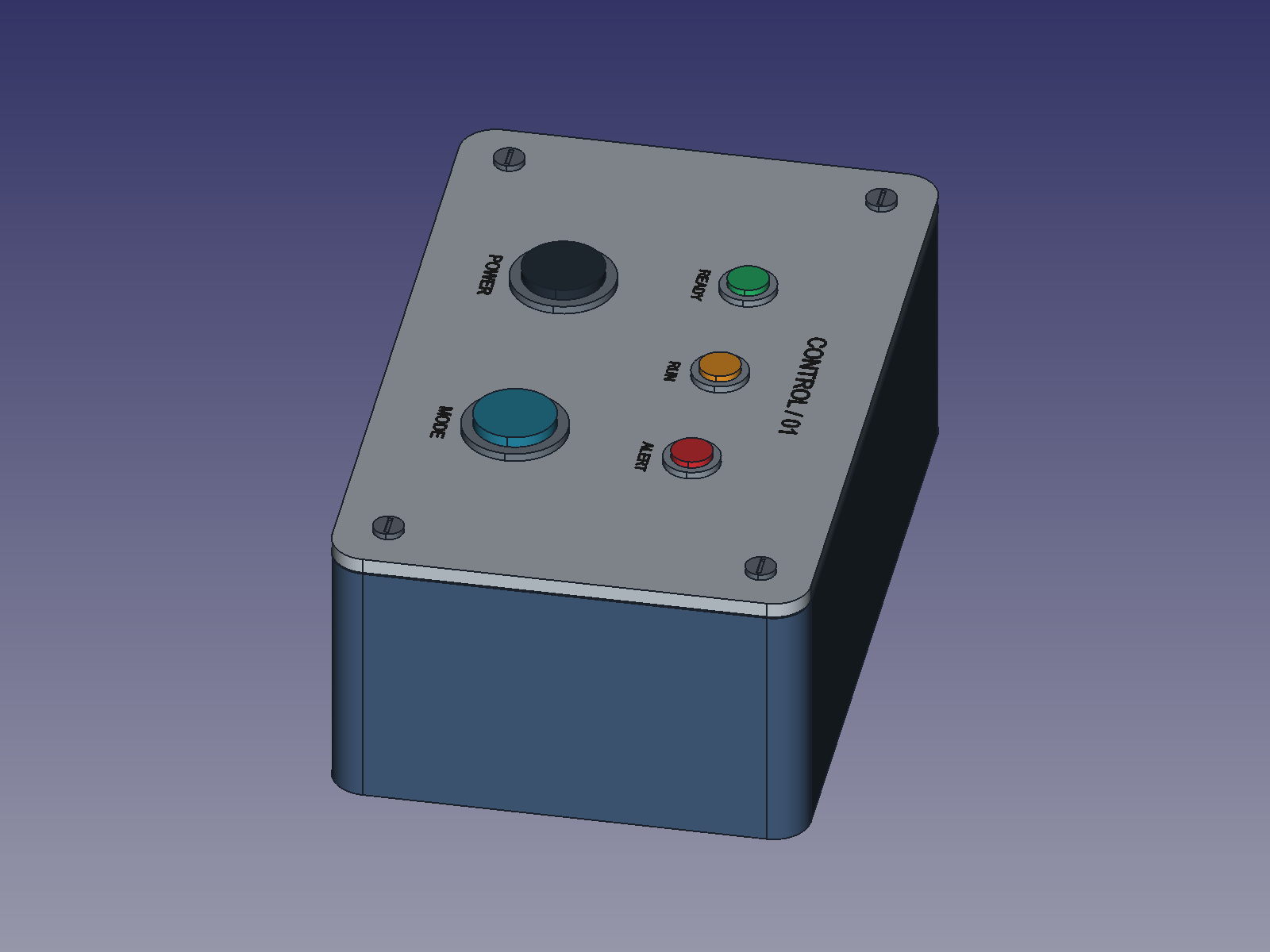
A representative brief for the model was: create a rounded 140 × 90 × 50 mm control box with 3 mm walls and floor, a separate 3 mm lid, four screw positions, internal supports, cable access, three 8 mm indicator openings and two 16 mm switch openings. This reconstructs the implemented requirements; it is not presented as a verbatim quote of Finn’s original prompt.
Codex translated the requirements into named values in a FreeCAD spreadsheet: length, width, height, wall, lid thickness, indicator and switch diameter, and screw clearance. The operation history used those values to form the rounded outer shell, subtract the inner volume, place posts and cable access, and finally cut the lid openings. The result was not a frozen mesh, but a native parametric history that could recompute when a value changed.
The recorded demonstration made this visible by changing the switch openings from 16 to 19 mm, recomputing the model, then restoring 16 mm and recomputing again. The change propagated through the dependent lid operations. This is a concrete reason to preserve parameters and native files rather than only the final image.
Task-local Python sent bounded commands to FreeCAD through a local XML-RPC bridge. OBS Studio was controlled separately through its local WebSocket; the CAD bridge and recording control were not the same interface. After capture, English narration used the paid Azure voice Ryan, captions were supplied, and the finished MP4 masters went through encode/container quality checks before scheduling, private archival and public release.
What “built with Codex” actually means
A prompt does not replace requirements, sources or verification
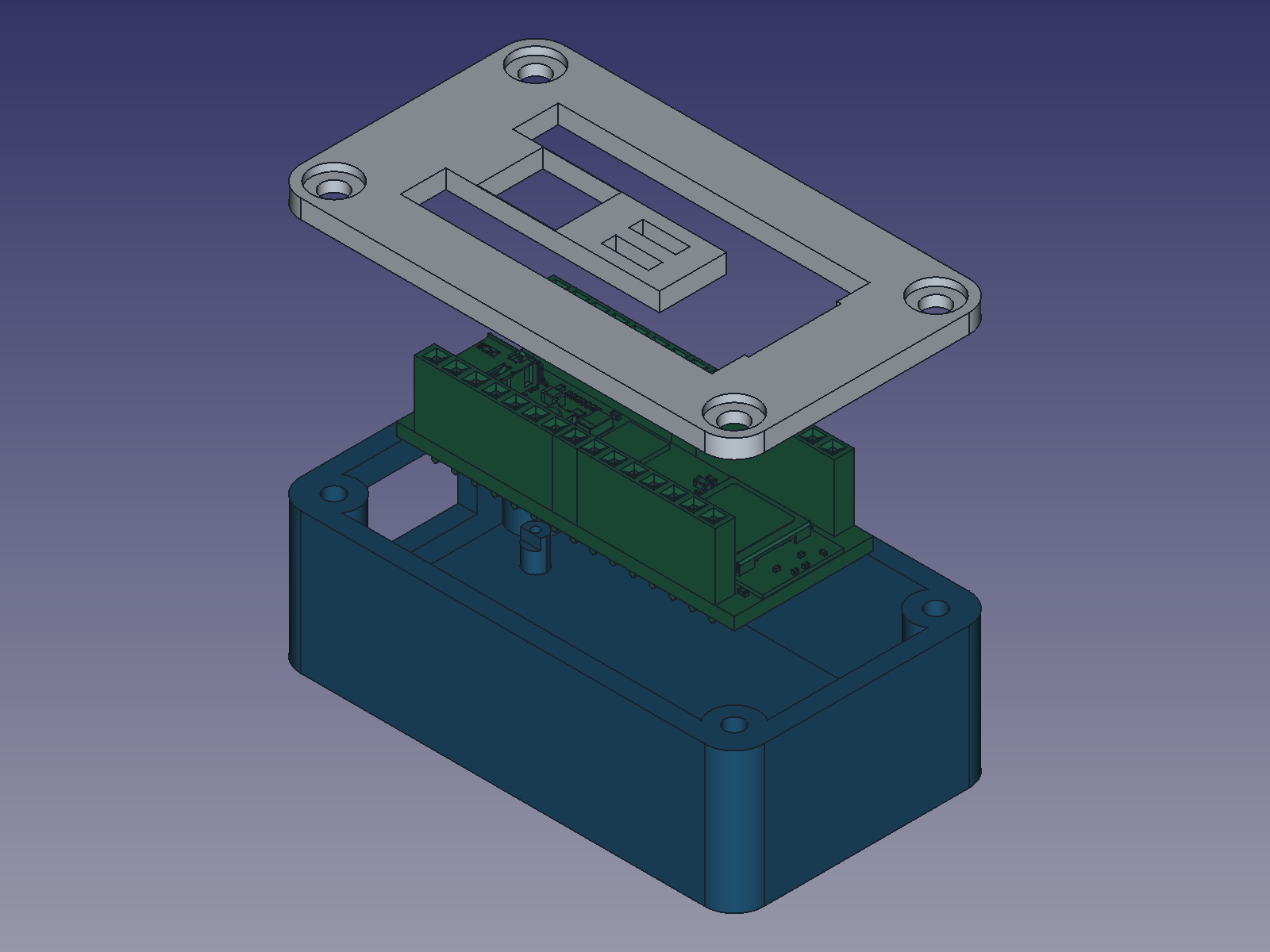
The work began with a need: an enclosure, a defined component volume, accessible connectors, supports, lid, ventilation and inspectable exports. Official drawings and documentation were used where available. Dimensions, mounting patterns, connector locations and component envelopes had to be reconciled before modelling.
Codex was used as a coding, CAD-automation and verification assistant. Execution occurred in the native FreeCAD application through task-local Python and a loopback native-app bridge on the workstation. That bridge was separate from OBS control, published no credentials and did not expose FreeCAD to the internet.
- Translate the brief into dimensions, tolerances, access and explicit boundaries.
- Check official drawings and documentation for the relevant hardware revision.
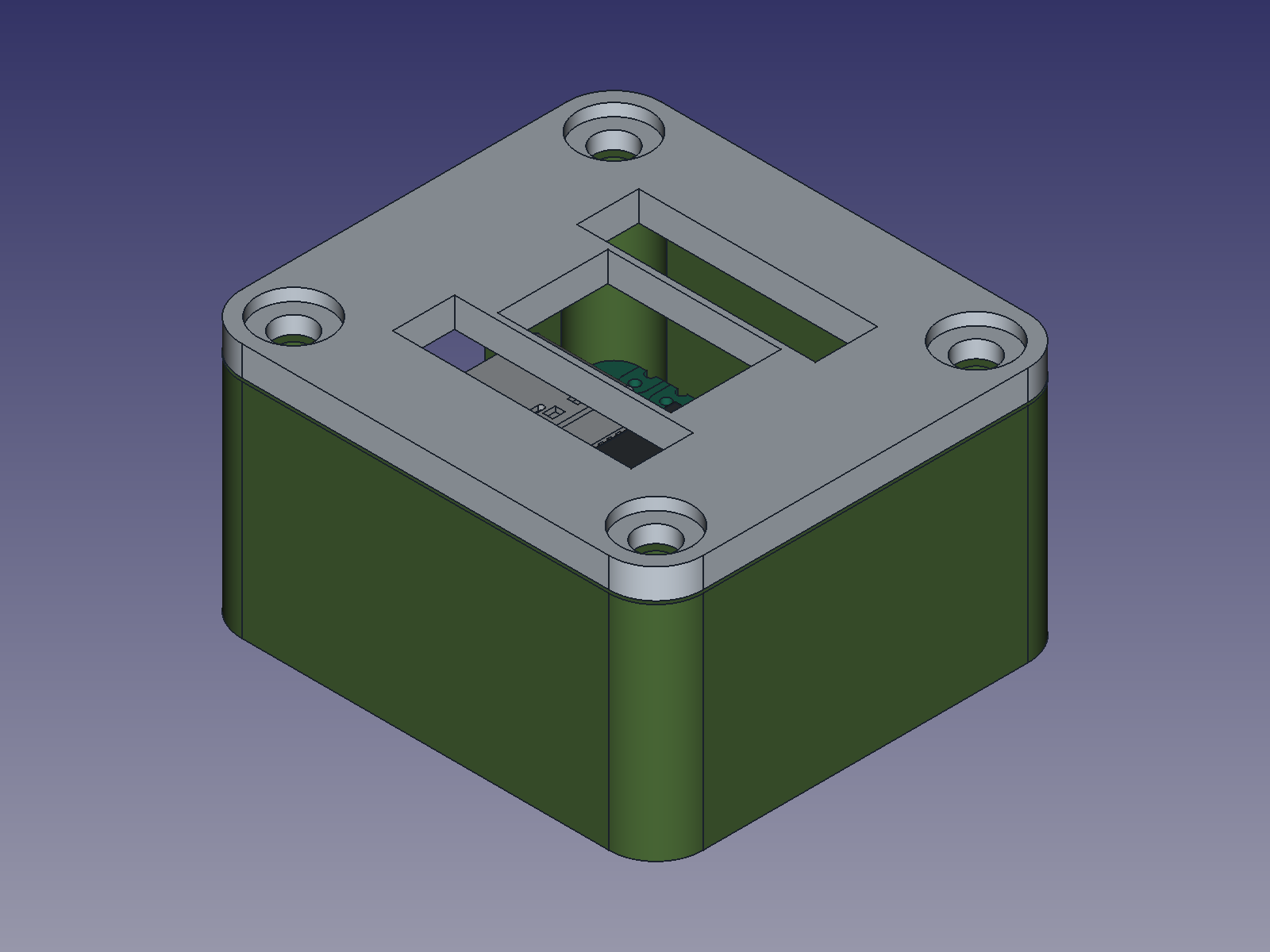
- Build the parametric shell, supports, openings, ventilation and lid in native FreeCAD.
- Recompute, inspect solids and export FCStd, STEP and STL with known limitations.
Public project index
Source, native file, exports and video together
The YouTube links were scheduled for 12 October 2026 in Europe/Oslo. A scheduled link is not proof that a video is already public. Every approved MP4 therefore also has a direct, hash-checked fallback in the GitHub release.
Checked 12 October 2026
What the evidence covers
- The public package contains 240 source files, 19 FCStd, 30 case-only STL, 15 case-only STEP and one KiCad component STEP file.
- All 19 FCStd files were downloaded from the exact public commit, opened and recomputed in native FreeCAD without being resaved.
- The final base and lid objects were checked as valid single solids.
- STL boundaries and non-manifold edges were checked mechanically; published hash manifests can be rerun.
Still unknown
What file checks do not prove
- Physical fit against the exact hardware revision in your hand.
- The selected printer, material, tolerance, screws and threaded inserts.
- Temperature, ventilation, RF, strain relief, electrical safety or compliance.
- That a prototype is production-ready or certified.
From native work to explanation
The videos show the real tool
OBS captured work in the native application. Narration was then produced with a paid Azure voice named Ryan, and captions were supplied. Each master was checked before scheduling, privately archived with a hash, and published as a sanitised copy. All 15 public MP4s were subsequently downloaded anonymously from the GitHub release and matched against the approved SHA-256 values and exact byte counts.
OpenAI Codex is credited because it was a real part of the workflow. This is an independent project and is not sponsored, certified or endorsed by OpenAI, FreeCAD or the hardware vendors.
Rights boundary: Official vendor drawings and board models were used as references where appropriate, but are not republished as my work. The GitHub library contains original case files, images, scripts and documented links to source material.
Frequently asked questions
Can I download and modify the models?
Yes. Original project source and documentation are under the MIT License. Original package images, captions and videos are CC BY 4.0. Read the third-party notices before reuse.
Are the files ready to print without checking?
No. Measure the hardware you actually have, inspect connectors and cable overmoulds, choose tolerances for your printer and material, and perform your own thermal and mechanical tests.
Why provide FCStd, STEP and STL?
FCStd preserves the native editable model. STEP supports interchange and further CAD inspection. STL describes print geometry but loses parametrisation and much of the design intent.
Can Finnandre deliver this kind of customer project?
Yes. An engagement starts with scope and source verification. Scope and price are agreed after the need, hardware, test requirements and delivery formats are understood.